Article | Adaptive Spaces
Bangkok Retail Market H1 2026: Experience Is Now the Product
October 16, 2026
- No major new retail developments launched in Bangkok in H1 2026. The story of the Bangkok retail market this year is about repositioning and reinvention, not new supply.
- Physical retail is no longer competing primarily against other shopping centers. It is competing against social media, streaming and gaming for consumer time and attention.
- The most successful retail concepts in 2026 are built around specific communities and shared interests rather than broad category appeal.
- F&B now accounts for 30%–40% of gross leasable area in leading retail centers globally, up from roughly 15%–20% a decade ago. Bangkok is following the same trajectory.
- Health and wellness is the most active category for international brand expansion into Thailand in 2026, ahead of F&B.
- Pet-friendly infrastructure has moved from optional amenity to a meaningful differentiator for Bangkok retail destinations targeting younger urban consumers.
- International brand interest in Thailand remains strong despite broader economic uncertainty, supporting ongoing retail expansion in Thailand and attracting a more diverse mix of Korean, Japanese, European and American entrants in 2026 compared to the China-dominated wave of 2025.
The Bangkok Retail Market in 2026: Reinvention Over Expansion
The Bangkok retail market in the first half of 2026 has been defined less by new supply than by how existing assets are being repositioned. No major developer launched a significant new retail project in Bangkok during the period. Instead, the market has been characterized by asset refurbishment, concept evolution and a growing focus on community-oriented formats that serve local lifestyle needs rather than simply adding floor area. These shifts reflect broader Bangkok shopping mall trends, where landlords are prioritizing experience-led concepts, wellness offerings and community engagement over traditional expansion-driven strategies.That does not mean the market is standing still. Several local developers and landowners are evaluating small- to medium-scale retail developments across emerging residential catchments in the Bangkok Metropolitan Area, including Bang Na and Ratchaphruek. Many local retailers have remained selective about expansion amid economic uncertainty and evolving consumer spending patterns. But international brands continue to view the Thailand retail market [RS2.1]as one of Southeast Asia's most attractive opportunities, supported by strong tourism fundamentals, a large urban consumer base and sustained demand for differentiated retail experiences.
The more significant shift is structural. Bangkok's retail market is in the middle of a transition from shopping destination to lifestyle ecosystem—a change driven not by supply dynamics but by a fundamental change in what consumers want from physical retail.
Bangkok Shopping Mall Trends: What Consumers Actually Want Now
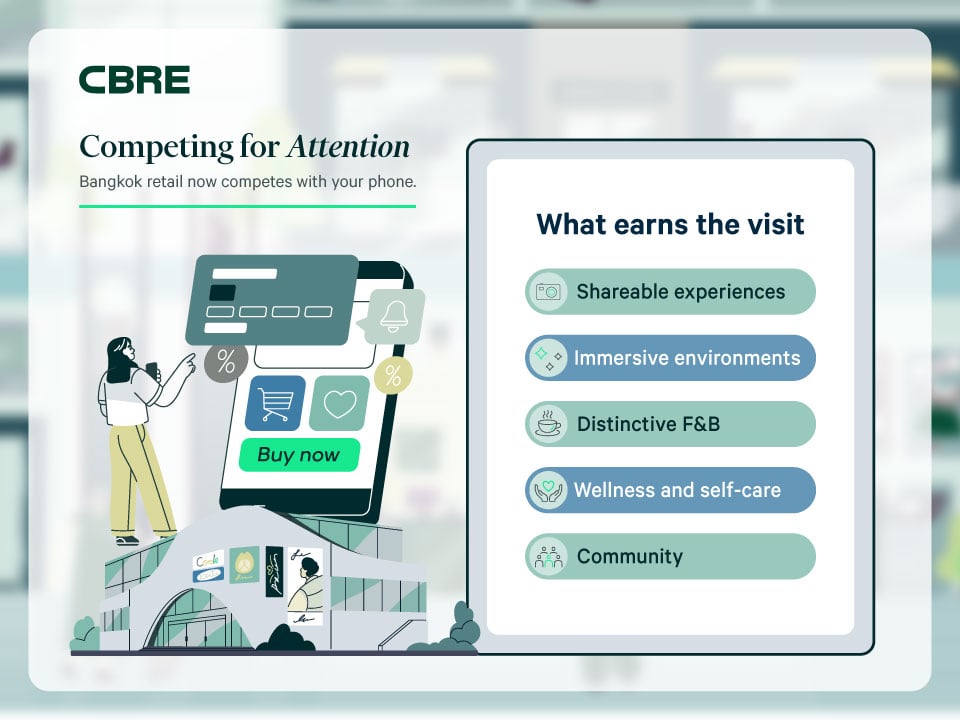
The challenge facing retail destinations in Bangkok in 2026 is more complex than it was a decade ago. Physical stores are no longer competing solely against other shopping centers for consumer spending. They are competing against social media platforms, streaming services, gaming and every other form of digital entertainment for consumer time and attention. In that context, a retail visit that offers nothing beyond the ability to buy things is a hard sell.For Gen Z and younger Millennials in particular, the primary motivation for visiting physical retail is no longer the transaction. It is discovery, social interaction, content creation and community. For landlords and retailers, the implication is clear: earning this group’s time offline requires giving them a genuine reason to visit, as the next section explores.
The retail concepts that are resonating most strongly in Bangkok right now are the ones that have built their entire proposition around this reality, rather than treating experiential elements as a bolt-on to a traditional retail format.
Gen Z Is Redefining What Bangkok Retail Is For
Behind many of the trends reshaping Bangkok's retail market in 2026 is a fundamental shift in consumer behavior, particularly among Gen Z and younger Millennials. Unlike previous generations, this group increasingly views shopping centers as social and cultural destinations rather than transactional venues. The primary motivation for a physical retail visit is no longer purchasing products — it is discovery, community, content creation and self-expression.Gen Z consumers are highly digital but increasingly selective about how they spend time offline. The destinations that earn that time are those offering something genuinely worth the visit: shareable experiences, immersive environments, distinctive F&B, wellness and self-care options, sustainability-focused concepts, pet-friendly spaces and opportunities to connect with people who share their interests.
A related characteristic is the preference for discovery. Online platforms offer convenience and efficiency, but physical retail offers something algorithms can't replicate: unexpected encounters, limited-edition products, local brands and the kind of community experience that only happens in person. Retailers are increasingly designing spaces that encourage exploration and longer visit durations, and measuring success not just by sales per sqm but by engagement, dwell time and repeat visitation.
Community-Driven Retail: The Experiential Retail Bangkok Model
1981 Soul & Sold
One of the most discussed retail concepts to emerge in Bangkok in 2026 is 1981 Soul & Sold on Ramkhamhaeng Road. The project dedicates substantial space to curated second-hand fashion, vintage apparel, vinyl records, tattoo studios and creative lifestyle operators—a deliberate departure from conventional retail formats.The concept is well timed. The global second-hand apparel market is estimated to surpass US$350 billion within the next few years, growing considerably faster than traditional fashion retail as consumers prioritize sustainability and individuality over volume. In Bangkok, that trend is visible in the growth of vintage markets, resale platforms and community-driven fashion events that have attracted a loyal and growing following among younger urban consumers.
What 1981 Soul & Sold demonstrates is that nostalgia and subculture are no longer just marketing themes in retail—they are viable organizing principles for an entire development. The project functions less as a shopping center and more as a social platform where consumers with shared interests can gather, interact and build community. That distinction is what makes it relevant to the direction Bangkok retail is heading.
F&B-Led Retail: How Food Is Driving Footfall in Bangkok's Retail Market
Food and beverage has consolidated its position as one of the most reliable drivers of retail traffic in Bangkok. Globally, leading retail centers now dedicate 30%–40% of gross leasable area to F&B concepts, compared with roughly 15%–20% a decade ago. Bangkok's major retail assets are following the same trajectory, and the formats being introduced reflect the same experience-over-transaction logic driving change across the rest of the market.PLATINUM POP, Ratchaprasong
PLATINUM POP in Ratchaprasong illustrates how Bangkok landlords are experimenting with F&B to reposition and reactivate their assets. The introduction of the LAI JIE Zone, bringing together more than 150 Chinatown-inspired food vendors, is designed to create a multi-sensory environment where food, social interaction and entertainment are the primary draws rather than the product categories around them.The addition of Thailand's first EVEANDBOY Café reflects a parallel trend: brands blurring the boundary between retail, lifestyle and hospitality to extend dwell time and generate social media engagement. Whether these formats sustain their initial momentum over the longer term remains to be seen, but PLATINUM POP is a useful example of how landlords are rethinking the role of physical space in a market where attention is the scarce resource.
Wellness Moves from Amenity to Bangkok Retail Strategy
Wellness has moved from a tenant category into the design and development philosophy of Bangkok's retail assets. The shift reflects growing consumer interest in health, longevity, active lifestyles and mental wellbeing that is reshaping how developers plan and position new projects.Central Northville, Nonthaburi
Central Northville is the clearest example of this approach in Bangkok's current retail market. Positioned as Thailand's first outdoor-inspired indoor shopping center, the project incorporates a 500 sqm indoor forest, dedicated wellness zones, a 450m jogging track, enhanced natural lighting and air circulation, family-focused Playville spaces and pet-friendly Petville facilities.The project reflects a broader point about where retail investment is going: wellness is no longer limited to fitness operators, spas or healthcare tenants as a tenant mix consideration. It is being integrated into the physical design and operating philosophy of the asset itself. Retail destinations that make consumers feel better—physically and mentally—for having visited have a structural advantage over those that don't.
The Pet Economy as a Retail Differentiator
Pet-friendly infrastructure has become a meaningful point of differentiation for Bangkok retail destinations targeting younger urban households. For this segment, the ability to include pets in recreational and shopping activities has become a genuine factor in deciding where to spend time.Developers are responding with dedicated pet zones, pet parks, pet-friendly dining and leisure spaces, specialized pet services and enhanced sanitation and waste-management systems. What was previously an optional amenity in retail planning is becoming an expected feature in community-oriented and lifestyle-focused developments. Pet owners represent an affluent and highly engaged consumer segment, and the retail assets that accommodate them well tend to benefit from stronger repeat visit frequency.
Retail Expansion in Thailand: What's Entering the Market in 2026
International brand interest in Thailand remains strong despite broader economic uncertainty. Ongoing retail expansion in Thailand reflects continued confidence in the country's long-term consumer fundamentals. While 2025 was dominated by aggressive expansion from Chinese operators, particularly in F&B and consumer technology, 2026 is seeing a more diverse mix of entrants from Korea, Japan, Europe and the U.S.Notable market entries and expansions in H1 2026 include:
- Human Made & Curry Up (Japan)
- Bread Ahead (United Kingdom)
- Club Pilates (United States)
- Tagi (Shanghai)
- No Brand (Korea)
- Lopia (Japan)
- The Row (United States)
- IPPE KOPPE (Japan)
- MST Golf (Malaysia)
- Berwick 1707 (Spain)
Health and wellness is the most active category for expansion, ahead of F&B—consistent with the broader trend toward lifestyle and wellbeing that is reshaping Bangkok's retail market. Many incoming brands are also exploring more flexible market-entry structures, including franchise agreements, joint ventures and co-investment models, rather than relying solely on traditional leasing arrangements. The continued arrival of international brands is also supporting demand for retail leasing in Bangkok, particularly in prime shopping districts and mixed-use developments that offer strong foot traffic and visibility.
The outlook for the Bangkok retail market remains positive despite limited new supply. The market's evolution is increasingly being driven by experience, community and lifestyle rather than expansion alone. As Bangkok shopping mall trends continue to favor experiential concepts, wellness-driven destinations and stronger food and beverage offerings, landlords are placing greater emphasis on creating environments that encourage longer visits and repeat engagement.
Looking ahead, continued retail expansion in Thailand and sustained interest from international brands should support occupier demand and retail leasing in Bangkok. The assets most likely to outperform will be those that successfully align with changing consumer expectations and deliver experiences that cannot be replicated online.
Frequently Asked Questions About Bangkok's Retail Market
Is the Bangkok retail market growing in 2026?
The Bangkok retail market is not growing primarily through new supply in 2026—no major new retail development launched in the first half of the year. Growth is coming instead from asset repositioning, concept evolution and the expansion of international brands into the market. Consumer demand for experiential, lifestyle-oriented retail remains strong, and international brands continue to view Thailand as one of Southeast Asia's most attractive markets.What retail trends are shaping Bangkok shopping malls in 2026?
The dominant trends are the shift toward experience-led and community-driven retail, the expansion of F&B as a footfall driver, the integration of wellness into retail design and development, the growth of pet-friendly infrastructure and the continued diversification of international brand entrants. Across all of these, the common thread is that successful retail destinations in Bangkok are competing for consumer time and attention, not just spending.What is the outlook for retail expansion in Thailand?
Retail expansion in Thailand remains active despite economic uncertainty. International brands continue to enter the market, particularly in health and wellness, food and beverage and lifestyle categories. Bangkok remains the primary focus, although interest in selected regional markets is also increasing.Which international brands have entered the Thailand retail market in 2026?
Notable entries in H1 2026 include Human Made and Curry Up from Japan, Bread Ahead from the U.K., Club Pilates and The Row from the U.S., No Brand from Korea, Lopia and IPPE KOPPE from Japan, Tagi from Shanghai, MST Golf from Malaysia and Berwick 1707 from Spain. Health and wellness brands represent the most active expansion category, reflecting the broader shift in consumer priorities across the Bangkok retail market.What is driving demand for retail leasing in Bangkok?
Demand for retail space for rent in Bangkok is increasingly supported by international brand expansion, experience-led retail formats, lifestyle-focused destinations and the ongoing need for high-quality space in established retail districts.What is experiential retail and why does it matter in Bangkok?
Experiential retail refers to formats designed to offer consumers something beyond the ability to purchase products, whether through community events, immersive environments, curated F&B, wellness programming or cultural experiences. In Bangkok, it matters because retail destinations are no longer competing solely against other shopping centers for consumer time. They are competing against social media, streaming and gaming. Formats that give consumers a genuine reason to visit in person (and to return) have a structural advantage over those that don't.How is CBRE involved in the Bangkok retail market?
CBRE Thailand advises retail developers, landlords and international brands across the full scope of retail real estate activity—from market entry strategy and site selection through to leasing, asset management and investment advisory. For further information on retail market conditions in Bangkok or Thailand, please contact our Retail team.
Disclaimer:
At CBRE, we prioritize the accuracy and integrity of our market information. While we use generative AI tools to assist in the composition and optimization of its presentation, all information is based on proprietary research and the profound insights from our experienced property professionals. Every article undergoes a thorough human review and fact-check to ensure it meets our standards for professional quality and technical accuracy.