Intelligent Investment
Higher-for-Longer Rates: Implications for Commercial Real Estate
October 28, 2026 3 Minute Read

Executive Summary
- The 10-year Treasury yield has remained near or above 5% since Sept. 10, its highest level since 2007. The spread between the average commercial real estate cap rate1 and the 10-year Treasury yield has compressed to about 160 basis points (bps), a record low and well under its long-run average of roughly 325 bps.
- With the spread to the 10-year Treasury yield so narrow, cap rates have moved higher as rates increased. The pressure is greatest on multifamily and industrial asset pricing, where cap rate spreads to the 10-year Treasury yield are historically compressed at less than 100 bps.
- We expect cap rates will generally rise by at least 40 to 60 bps over the near term as rent growth likely will not offset the higher cost of debt capital.
- Higher-for-longer rates open opportunities in prime office and retail assets, as well as debt investments. Sectors facing a supply overhang and looming debt maturities, such as Sun Belt multifamily, could present opportunities for well-capitalized buyers to purchase assets at a discount.
Impact of Higher Rates
The rapid increase in U.S. Treasury yields—and uncertainty about their future direction—will have immediate impacts on commercial real estate investment activity in coming quarters. Previously when the 10-year Treasury yield spiked, wider existing spreads between real estate yields and the benchmark rate would give room for spreads to narrow, muting some of the impact on pricing.
Today, however, spreads are historically narrow and expectations are that long-term rates will remain elevated for some time. Consequently, the impact of rising rates on real estate asset prices will flow through more quickly
Cap rates have already begun to rise, with deals under contract being retraded and some planned sales turning into refinancings instead. Cap rate increases of 40 to 60 bps imply average property value declines of 6% to 10%. Multifamily and industrial assets, which have the lowest cap rates and thinnest spreads, are likely to feel the effects most acutely. Prime office and retail assets, by contrast, trade at wider spreads to the 10-year Treasury yield, so we expect less impact on their cap rates.
While the impact of interest rate fluctuations is significant, real estate values are largely driven by supply and demand. New supply is near historic lows for office and retail, and completions of logistics facilities have decreased in recent years, which will support fundamentals in those sectors. Sun Belt multifamily faces a supply overhang and upcoming debt maturities, which will likely weigh on pricing.
CBRE expects higher bond yields to reduce real estate investment activity over the next six months before activity improves as rates stabilize. Nevertheless, deals will continue to get done as some sellers stop holding out for a better environment and others confront upcoming debt maturities. With more expensive debt thinning bidder pools, the coming quarters should offer a window for debt funds, as well as opportunistic and well-capitalized investors.
The Bottom Line
Cap rates will increase as pricing adjusts to higher-for-longer rates. Amid this challenging environment, investors will find the most attractive opportunities in commercial real estate debt. Elsewhere, office and retail assets will be relatively more attractive, reflecting their wider spreads and stronger growth prospects.
Today’s environment differs from the one that existed when the Fed hiked short-term rates in 2022 and 2023. Though risks to our forecast remain, we believe long-term interest rates will stabilize more quickly than they did in the post-pandemic period and begin to drift lower in 2027. As the inflationary impact of supply shocks lessens, this will set the stage for the Fed to cut short-term rates in 2028. All of this underpins our thinking that following a few slower quarters, investment volumes should pick up in H2 2027, barring any macroeconomic shocks.
Figure 1: 10-Year Treasury Yield vs. Cap Rates
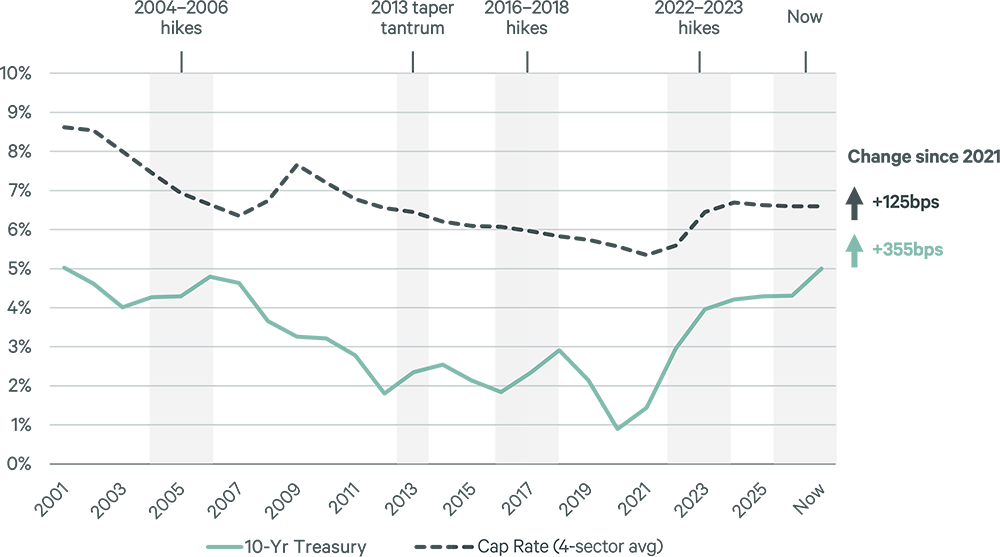
Source: CBRE Research, CBRE Econometric Advisors, Federal Reserve, October 2026.
Contacts
Amos Lim
Associate Director, CBRE Hotels & Investor Research